
Article · Oct 23, 2026
Robotics and children’s thinking: what does research say?
From planning a robot’s route to trying again after a wrong turn, hands-on robotics can offer playful practice in problem-solving. Here is what research tells us—and what it does not.
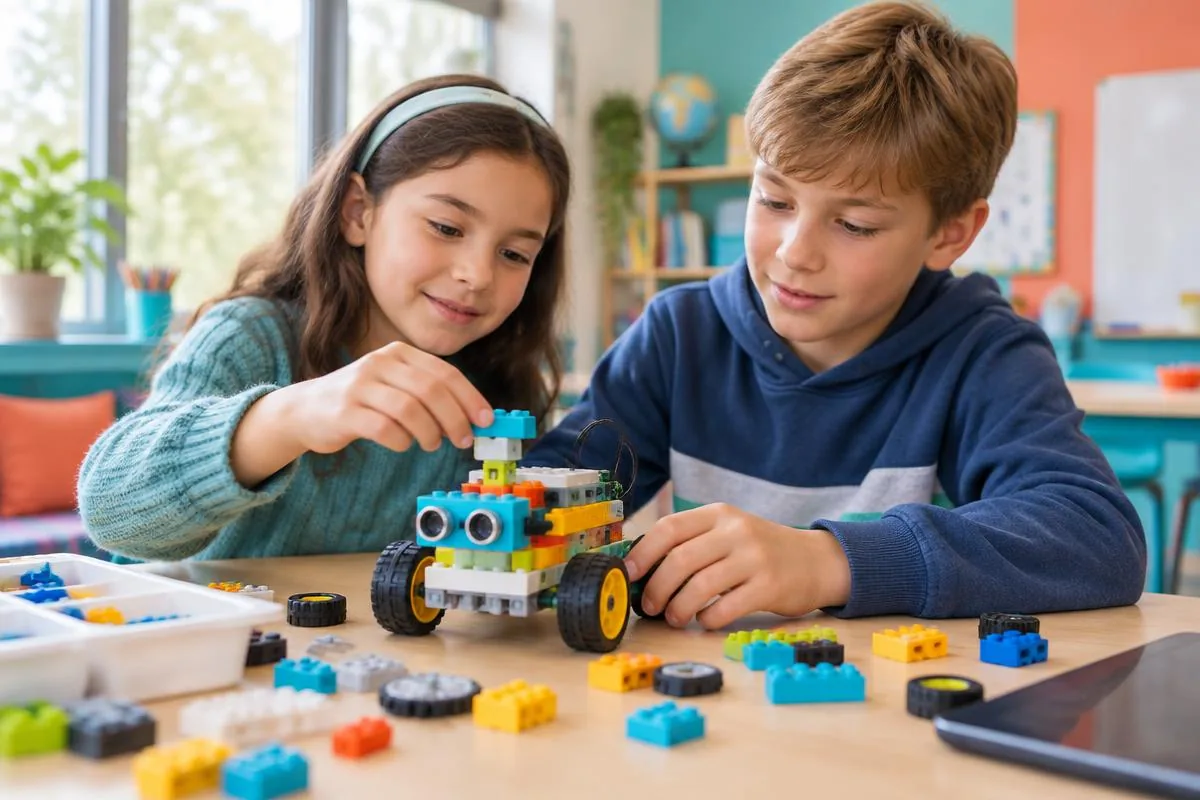
A small robot, a set of direction cards, and a child’s plan for reaching a target may look like play—and it is. It can also give children a hands-on way to practise ideas used in early computing and problem-solving.
Small robots, big thinking opportunities
In a typical activity, a child gives a robot a sequence of instructions, watches what happens, and adjusts the plan if it turns the wrong way. That cycle can introduce sequencing (putting steps in order), debugging (finding and fixing an error), and simple algorithmic thinking.
A 2023 systematic review by Ching and Hsu examined 22 peer-reviewed studies involving children from pre-kindergarten through Grade 6. These were among the computational-thinking skills most often explored. Activities frequently involved collaboration and projects, rather than children working only on a screen. The review describes a growing research area, not a guarantee that every robot or lesson produces the same results.
Planning, remembering, and changing a plan
Executive functions are skills involved in holding instructions in mind, controlling impulses, and changing a plan. In a randomized study published in 2020, Di Lieto and colleagues studied 187 children aged five and six using structured Bee-Bot activities. They found improvements on some measured executive-function outcomes.
This is encouraging evidence for a particular program and age group. It does not show that every robotics club improves executive function, that gains necessarily transfer to unrelated schoolwork, or that they last over time.
What the wider evidence suggests
A 2024 meta-analysis by Alonso-García and colleagues reported an overall positive effect of educational robotics on computational thinking in early childhood. Combining results can help summarize evidence, but the teaching activities and tests differ between studies. The finding supports robotics as one potentially useful approach—not as proof that robots are essential or better than every other way of learning.
What parents can look for
The quality of the experience matters more than the gadget. Look for opportunities where children:
- Make their own predictions before running a robot.
- Explain why they chose a particular sequence of steps.
- Test an idea and have time to revise it.
- Work with a partner and listen to another possible solution.
- Celebrate discoveries rather than only getting the “right” answer.
You can explore related ideas without a robot, too. Draw a floor maze and take turns giving step-by-step directions, or use blocks to plan a route for a toy. Ask, “What do you think will happen?” and “What would you change?”
A careful word about the brain
These studies measure learning and performance on particular tasks. They do not establish that educational robots grow children’s brains, raise IQ, or increase general intelligence. Robotics is not a medical treatment or a guarantee of academic success.
The sensible takeaway is narrower: thoughtfully guided robotics offers an engaging setting to practise computational thinking, while early research suggests possible benefits on some measured executive-function outcomes. It is one option in a broad toolkit for playful learning.
Research sources
- Ching, Y.-H. & Hsu, Y.-C. (2023). Educational Robotics for Developing Computational Thinking in Young Learners: A Systematic Review. TechTrends. Read the review.
- Di Lieto, M. C. et al. (2020). Empowering Executive Functions in 5- and 6-Year-Old Typically Developing Children Through Educational Robotics: An RCT Study. Frontiers in Psychology. Read the study.
- Alonso-García, S. et al. (2024). Enhancing computational thinking in early childhood education with educational robotics: A meta-analysis. Heliyon. Read the meta-analysis.
This article summarizes educational research for families; it is not medical advice.